
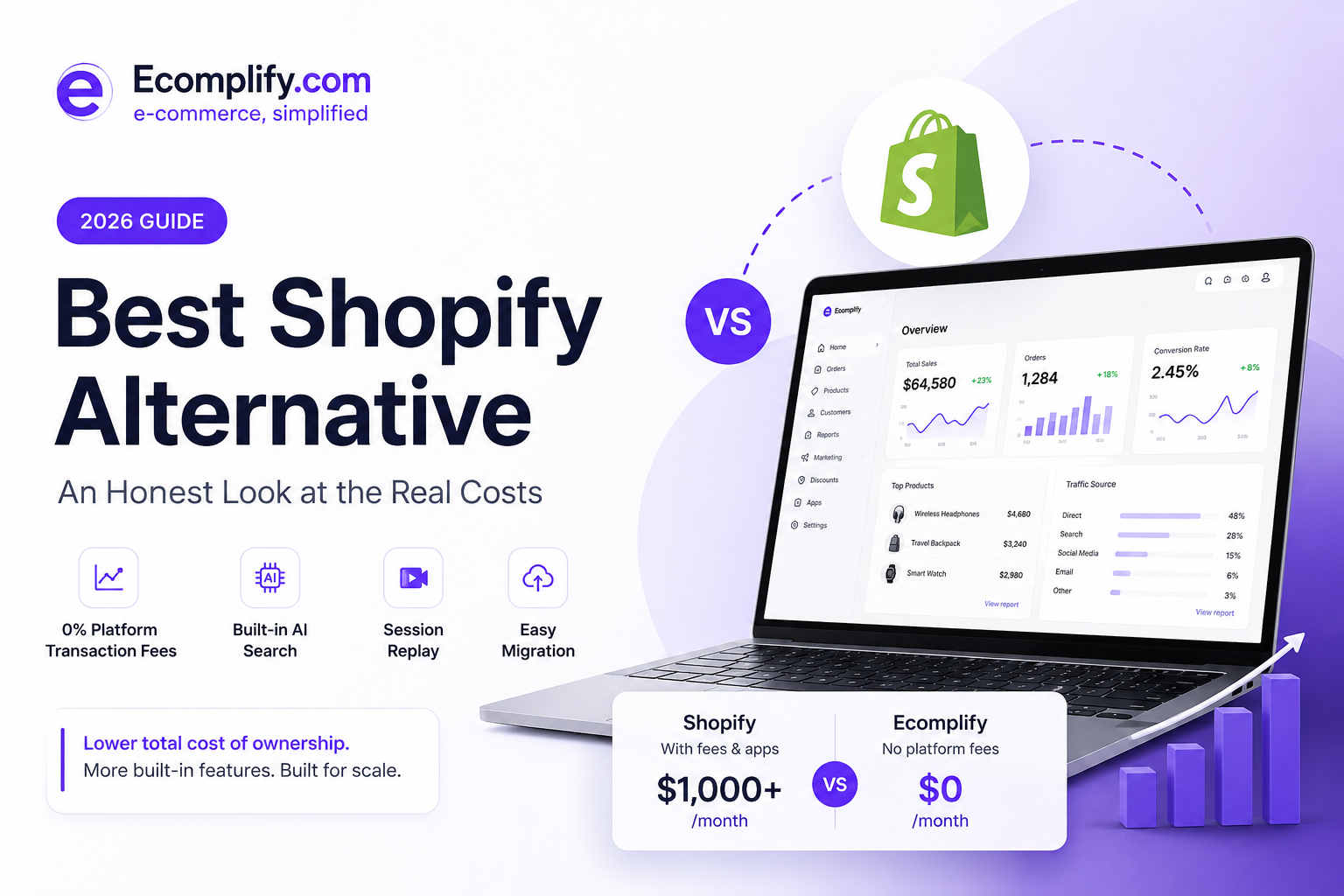
Search for an ecommerce platform, and Shopify is almost always at the top of the list. It has earned that reputation by powering millions of online stores worldwide with a mature ecosystem, reliable infrastructure, and an extensive app marketplace.
However, choosing an ecommerce platform is not just about the monthly subscription. As your business scales, transaction fees, paid apps, payment processing, integrations, and operational complexity all compound into the platform's total cost of ownership. For high-volume merchants and mid-market brands, these hidden costs often exceed the subscription itself.
Before committing to Shopify, it is worth understanding the complete picture and how modern ecommerce platforms compare in terms of cost, scalability, and built-in capabilities.
Understanding Shopify's Total Cost of Ownership
The advertised subscription is only part of the cost. As your store grows, additional expenses such as transaction fees, payment processing, third-party apps, and premium features can significantly increase your monthly operating costs.
Here's what a typical Shopify store may need to budget for:
| Cost component | Typical cost |
|---|---|
| Shopify subscription | Varies by plan and billing cycle |
| Payment processing fees | Varies by payment provider |
| Shopify transaction fees* | Applies when Shopify Payments is unavailable or not used |
| Premium themes | Optional |
| Third-party apps | Often required as your business grows |
*Transaction fee policies vary depending on your region, payment provider, and Shopify plan.
One of the biggest costs merchants overlook is Shopify's platform transaction fee. In regions where Shopify Payments is unavailable, or when another payment provider is used, Shopify charges an additional transaction fee on every order. That fee is charged on top of your payment provider's normal processing fee.
At scale, these fees become a material line item. A brand doing $1M in annual revenue with a 2% platform fee hands over $20,000 per year before a single app subscription is counted. Combined with app costs, theme fees, and platform subscriptions, the total cost of ownership is often 2–3x the advertised monthly plan. We've written more about this in our article on how platform transaction fees quietly eat margins.
What Modern Ecommerce Businesses Should Expect
Modern ecommerce platforms should reduce operational complexity, not add to it. Scaling brands should expect enterprise-grade capabilities to be built into the platform instead of relying on a patchwork of paid apps and additional platform fees.
- 0% platform transaction fees. Payment processing fees are unavoidable, but your ecommerce platform should not take an additional percentage of every sale. Ecomplify charges 0% platform transaction fees on every plan, allowing high-volume merchants to retain margin as they scale.
- Global payment flexibility. Connect the payment providers your customers already trust Stripe, PayPal, Apple Pay, Google Pay, Klarna, and Adyen without platform-imposed restrictions or penalty fees.
- Built-in shipping and logistics. Integrate with global and regional logistics providers without depending on multiple third-party apps.
- Multi-currency and multi-region support. Sell in USD, EUR, GBP, and other major currencies with localized checkout experiences built in.
- Transparent, predictable pricing. No surprise fees. No usage-based penalties. Know your platform cost before you scale.
Built-in Features That Reduce App Dependency
On Shopify, many advanced capabilities require installing third-party apps, each with its own monthly subscription and integration overhead. Ecomplify includes these capabilities out of the box, reducing vendor sprawl and total cost of ownership.
- Intelli AI Search. Customers can search using natural language such as "black waterproof hiking jacket under $100" and instantly find relevant products. Vision AI understands product images to improve search accuracy, even when product titles or tags are incomplete.
- Abandoned cart recovery. Automatically recover lost sales with built-in cart recovery emails and sequences no additional email app required.
- Action Replay. Watch real customer sessions to identify friction points, optimize conversion funnels, and improve the buying experience at scale.
- Bulk CSV import with AI enrichment. Import your entire product catalog in one upload. AI automatically enriches products with attributes such as colors, materials, and styles, cutting down manual merchandising time.
- Enterprise security and compliance. SOC 2-aligned infrastructure, GDPR-ready data handling, and SSL by default so your legal and security teams have one less thing to worry about.
When Shopify Is Still the Right Choice
An honest comparison goes both ways. Shopify remains an excellent choice for many businesses.
It may be the right platform if:
- You rely on a specific app that only exists in Shopify's ecosystem.
- Your team already has deeply embedded workflows built around Shopify.
- You require Shopify Plus or enterprise features that fit your existing operations.
- You are comfortable managing multiple third-party apps and their associated costs as your business grows.
If that describes your business, Shopify is a strong platform. However, if you want to eliminate platform transaction fees, reduce app dependency, and access AI-powered capabilities without stacking subscriptions, a unified architecture such as Ecomplify may deliver better long-term value for scaling brands.
Migration Built for Scale
Switching platforms is often the biggest reason businesses postpone change. Ecomplify's bulk import pipeline was built to minimize downtime and risk. Export your products as CSV, upload them, and the system handles products, images, variants, and AI-powered enrichment automatically.
Most catalogs are live, searchable, and ready to transact within the hour so your team can focus on revenue, not replatforming.
Start your 14-day trial → No credit card required. Zero platform transaction fees. No unnecessary app subscriptions.
Frequently Asked Questions
How much does Shopify cost per month?
Shopify's monthly cost depends on the plan you choose, your billing cycle, your payment provider, and your region. Beyond the subscription, many businesses also pay for payment processing, third-party apps, premium themes, and platform transaction fees where applicable. For mid-market brands, these ancillary costs often exceed the base subscription.
Does Shopify charge transaction fees?
Yes. Shopify may charge platform transaction fees depending on your plan and whether Shopify Payments is available or used in your region. These fees are separate from your payment provider's processing fees and scale directly with your revenue.
What is the best Shopify alternative for scaling brands?
The best alternative depends on your business requirements. If you are looking for zero platform transaction fees, built-in AI capabilities, fewer third-party dependencies, and transparent pricing designed for high-volume merchants, Ecomplify is built to help brands scale more efficiently.
Can I move my Shopify store to another platform without losing my products?
Yes. Export your products as CSV from Shopify and import them into Ecomplify using the built-in migration tools. Products, images, variants, and AI-powered product enrichment are handled automatically, making migration fast and straightforward for catalogs of any size.
Last updated August 5, 2026