
If you look at the entry-level pricing of traditional e-commerce software, the baseline subscription is almost always presented as an accessible, double-digit monthly fee. It is a clean, approachable number painted across marketing pages to welcome new business builders.
It is also one of the most misleading metrics in retail technology.
The reality is that for independent, scaling Direct-to-Consumer (DTC) brands, a base platform subscription represents only a tiny fraction of what you actually pay to keep your storefront running. The vast remainder is swallowed up by two silently scaling financial drains: the third-party plugin marketplace ecosystem and percentage-based platform transaction fees.
Right when an online store starts gaining traction exactly when a founder needs to protect margins to fund inventory and advertising traditional software infrastructures penalize that growth. Let’s break down the actual line-item economics of running a scaling storefront and look at why this structural "App Tax" might be draining your business.
Interactive Total Cost of Ownership Calculator
To help you visualize how these expenses accumulate at different sales volumes, configure your current monthly baseline using the calculation model below.
The Illusion of the Low-Cost Starter Store
When you launch a new digital storefront, a standard entry-tier plan feels like an exceptional bargain. You receive a basic checkout module, a structural database to host your product catalog, and a few default design templates.
Key points regarding legacy structures:
- Stripped-Back Cores: Base frameworks only provide structural basics. Advanced sales tracking or conversion tools require external add-ons.
- Marketplace Incentives: Platforms often monetize their app ecosystems via rev-share cuts, keeping them disincentivized from adding high-end features natively.
- The Scaling Trap: As your order volume increases, what started as a simple $39 setup scales aggressively in complexity and real operational cost.
This creates a structural conflict of interest for growing businesses. Traditional platform models are inherently incentivized to leave performance and marketing features out of their core product because they profit directly from processing rev-share cuts inside their proprietary third-party app marketplaces. For independent merchants, this means that scaling monthly revenue from $5,000 to $50,000 quickly forces you into an expensive loop of software patchworks.
Breaking Down the Marketplace "App Tax"
To achieve competitive conversion rates, modern merchants cannot rely on standard, bare-bones software functionality. Customers expect intelligent search bars, personalized shopping elements, instant mobile loading times, and crystal-clear analytics.
Because legacy architectures omit these features from their primary builds, you are forced to deploy third-party integrations. This is where the "App Tax" accumulates.
Consider the monthly recurring subscription expenses for basic utilities required to operate an optimized digital storefront:
- Advanced Intelligent Site Search: Basic keyword matching software frequently fails to interpret user intent. Upgrading to an algorithmic, natural-language search plug-in costs an average of $49/month to start.
- Conversion Optimization & User Tracking: Watching exactly how real users move through your funnel to resolve checkout drop-offs via session recordings runs roughly $39/month.
- Performance & Image Optimization: To prevent heavy assets from destroying mobile ad conversions, specialized speed apps add $29/month.
- Advanced Segmented Analytics: Tracking regional drops and device-specific conversion drops adds another $25/month.
Within a few clicks, a lean operational bill balloons well past $180/month before accounting for core payment processing overhead.
The Hidden Performance Penalty: JavaScript Bloat
The direct financial expense of stacking plugins is only half the problem; the secondary penalty is technical. Every third-party script added to a traditional store framework injects external tracking links, disjointed pixels, and bloated stylesheets into the page header.
When a mobile browser attempts to open your site, it is forced to execute dozens of uncoordinated, competing scripts simultaneously. This code fragmentation actively degrades page load speeds, increasing bounce rates and directly driving up your customer acquisition costs.
The Hidden Math of Transaction Fees
Beyond monthly software add-ons, scaling brands encounter an operational obstacle: percentage-based platform transaction fees.
While most technology systems display clear payment processing percentages, many hide secondary transaction surcharges in their fine print. If you choose to process transactions through alternative local payment gateways, regional digital wallets, or international payment processors, traditional platforms tack an extra platform fee (often between 0.5% and 2.0%) on top of standard gateway rates.
| Monthly Store Revenue | Traditional Platform Surcharge Tier | Additional Platform Fees (Per Month) | Additional Platform Fees (Per Year) |
|---|---|---|---|
| $10,000 | Basic Tier (2.0% fee) | $200 | $2,400 |
| $30,000 | Basic Tier (2.0% fee) | $600 | $7,200 |
| $50,000 | Growth Tier (1.0% fee) | $500 | $6,000 |
| $100,000 | Enterprise Tier (0.5% fee) | $500 | $6,000 |
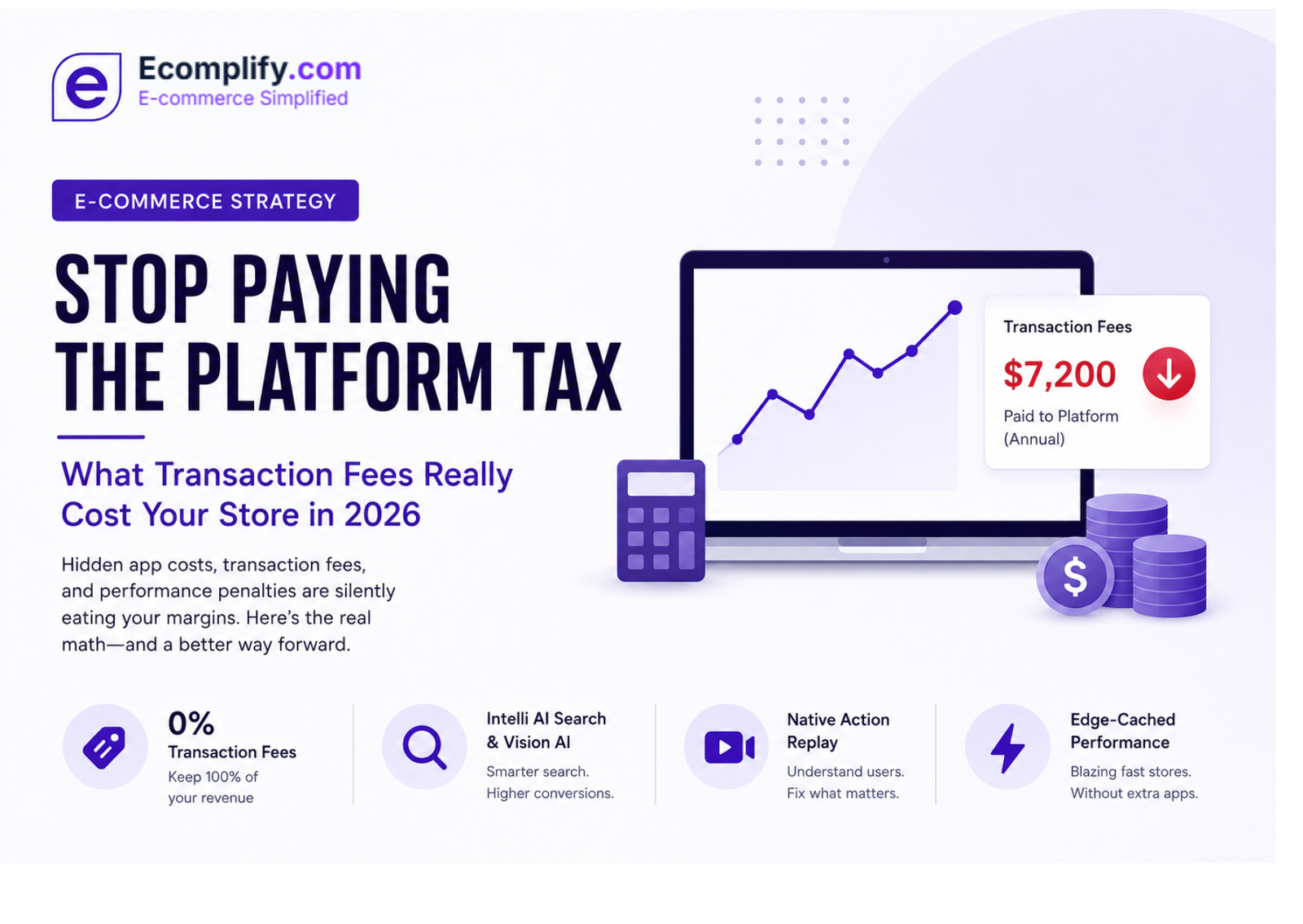
For a growing mid-sized brand generating $30,000 in monthly volume, this operational infrastructure fee can siphon away an extra $7,200 annually simply for using an optimal payment setup. These friction points target net profit margins, draining the critical working capital needed to scale inventory and fund marketing.
The Unified Alternative: Native Features, Flat SaaS Pricing
The solution to rising application fees and structural transaction penalties isn't to micro-manage your apps it’s to consolidate your underlying platform architecture. Scaling brands are increasingly migrating to clean, unified software models built to maximize efficiency out of the box.
By switching to a modern, fully integrated system like Ecomplify, you remove the recurring technical and financial bottlenecks of scaling a digital storefront:
1. 0% Transaction Fees Across the Board
Your hard-earned revenue should belong entirely to your business. By offering 0% transaction fees across all software plans, you can integrate your preferred local or global payment systems without encountering infrastructure markups.
2. Consolidated Enterprise Utilities Natively Built-In
Instead of trying to connect a fragile web of third-party plugins, Ecomplify builds advanced conversion tools directly into the foundational source code:
- Intelli AI Search & Vision AI: Offer advanced natural language search strings and automated visual catalog tagging instantly without paying for costly external modifications.
- Native Action Replay: Monitor live user interactions directly within your main management dashboard. This eliminates the need for heavy tracking scripts, keeping your store's underlying codebase clean and highly responsive.
- Edge-Cached Performance Tuning: Storefront data is deployed instantly across an optimized global edge network, handling asset rendering natively. Your store maintains elite mobile speeds without requiring premium optimization extensions.
Frequently Asked Questions (FAQs)
Do traditional e-commerce platforms charge extra fees for external payment gateways?
Yes. Many legacy software providers apply an extra fee (ranging from 0.5% to 2.0%) if you manage customer checkout options through third-party gateways or localized payment processors rather than their proprietary network. Ecomplify features 0% transaction fees, letting you choose your own merchant partners without platform markup penalties.
How does installing multiple marketplace plugins affect store performance?
Every plug-in added to a legacy framework introduces separate external JavaScript trackers and styling codes into your page header. When a customer loads your site on a mobile device, these scripts compete for processing priority, which can stall loading times and hurt your overall conversion rates.
Is it possible to migrate product data and customer histories safely?
Absolutely. Modern unified platforms utilize structured bulk import systems that allow you to securely transfer your historical customer profiles, product variants, and stock balances while completely maintaining your existing URL paths to preserve organic SEO rankings.
Stop Paying the App Stack Tax
An e-commerce platform should act as a reliable catalyst for your brand’s growth, not a growing tax on your financial operational success. If you are tired of watching your hard-earned margins disappear into unexpected subscription lines, transactional surcharges, and sluggish site performance, it’s time to build on a modern foundation.
Streamline your technology stack, maximize your mobile loading speeds, and retain full control over your transaction revenue.