
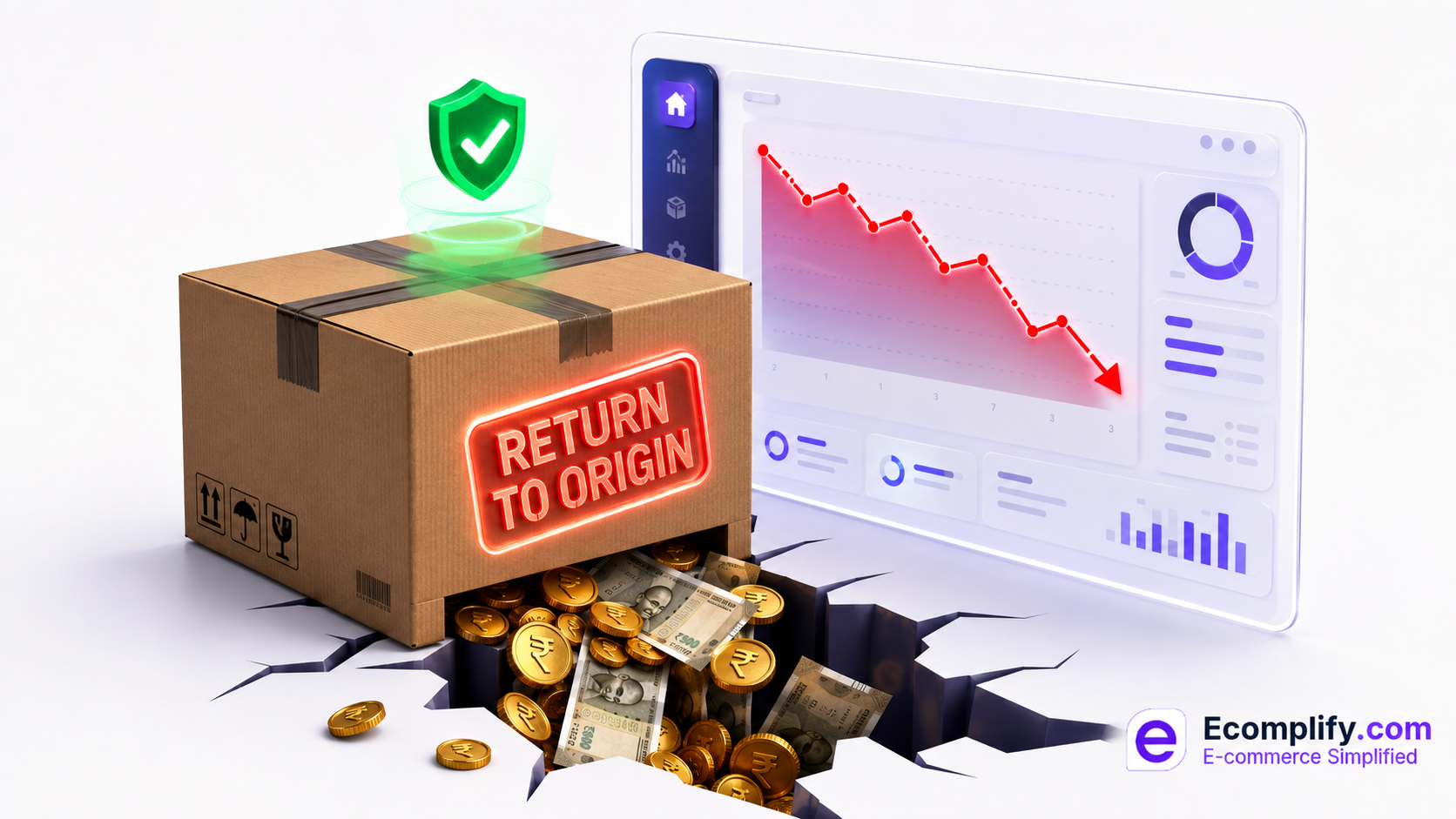
You just had your best sales month. One thousand orders shipped. The ads worked. The checkout converted. Your payment gateway settled the COD cash.
Then the returns started coming back.
Three hundred orders. Undelivered. Unwanted. Unreachable.
That is not a logistics problem. That is a profitability crisis - and for most D2C brands, it is happening every single month.
E-commerce RTO rate averages 20-30% for prepaid orders and 30-40% for COD orders in 2026. Fashion and footwear sellers on COD see rates as high as 35-48%.
Compare that to Western markets where RTO sits at 5-8%.
The gap is not because customers are harder to please. It is because ecommerce operates under a completely different set of structural realities - and most store owners are fighting RTO with the wrong weapons.
Here is what RTO actually costs you, why it happens, and the seven tactics that cut it by 30-50% - all without buying another SaaS subscription.
What One RTO Order Actually Costs You
Most founders only count the forward and reverse shipping fee. That is like calculating a car accident by the dent repair bill and ignoring the hospital stay.
Here is the real math for a typical Rs. 1,200 COD order:
| Cost Line | Amount |
|---|---|
| Forward shipping | Rs. 60-80 |
| Reverse shipping | Rs. 60-80 |
| Packaging materials | Rs. 15-30 |
| Warehouse QC and restocking | Rs. 10-20 |
| Product damage / write-off (5-10% of returns) | Rs. 50-100 |
| Customer acquisition cost wasted | Rs. 150-400 |
| Working capital locked in transit | 7-14 days |
| Total per RTO | Rs. 350-700 |
At a 30% RTO rate on 1,000 COD orders a month, that is 300 RTOs costing Rs. 1,05,000 to Rs. 2,10,000 every month. Over a year: Rs. 12.6 lakhs to Rs. 25.2 lakhs - enough to fund an entire marketing channel or hire a small team.
For brands in the under-Rs. 300 order value band, the true cost per delivered order can exceed the gross margin on the product itself.
That is not an optimization project. That is survival math.
Why RTO Is Structurally Different
Four forces make RTO a uniquely problem:
1. COD Dominance
60-65% of ecommerce orders are COD. Buyers can reject delivery at zero cost. Impulse purchases become impulse rejections.
2. Address Quality
18% of addresses have inaccurate or incomplete pincode-to-address mapping. A missing apartment number or wrong building name is all it takes.
3. Courier NDA Fraud
Delivery agents in Tier-3 areas sometimes mark orders as "customer not available" to avoid long-distance deliveries - even when the customer is home.
4. Product Mismatch
Poor product images cause "this is not what I expected" returns. Fashion leads at 32% of product-mismatch RTOs.
The 7 Root Causes of RTO (And What Actually Fixes Each One)
| Root Cause | % of RTOs | The Fix |
|---|---|---|
| Impulse / buyer's remorse | ~30% | COD order verification before dispatch |
| Customer unavailability | ~25% | Proactive delivery window communication |
| Address / contact errors | ~18% | Real-time address validation at checkout |
| No cash available at delivery | ~12% | Prepaid nudges with small discounts |
| Fraud / fake orders | ~8% | Pin-code risk scoring + OTP verification |
| Product mismatch | ~7% | Better product imagery + AI auto-tagging |
Notice something: Five of the top six causes are preventable before the package ever leaves your warehouse. RTO is not a delivery problem. It is a pre-dispatch data and communication problem.
The 7 Tactics to Cut RTO by 30-50% (All Inside Ecomplify)
You do not need Shiprocket + Pragma + Vyora + a calling team. Here is how to fix RTO using the tools already built into your Ecomplify store.
Tactic 1: Verify Every COD Order Before Dispatch
The data is unambiguous: pre-dispatch IVR or WhatsApp confirmation calls on COD orders above Rs. 500 reduce RTO by 15-25%.
The key is the 30-minute rule. Response rates on COD confirmation drop 40% after just 30 minutes from order placement.
How Ecomplify handles this:
- Auto-trigger WhatsApp confirmation messages the moment a COD order is placed
- One-tap confirmation - no app downloads, no typing
- Unverified orders auto-flagged for review before dispatch
- 8-14% of COD customers convert to prepaid when offered a small discount on the confirmation message
Tactic 2: Validate Addresses at Checkout (Not After)
A wrong address is a guaranteed RTO. Real-time address validation at checkout catches errors before the order is confirmed - suggesting corrections, flagging incomplete entries, and blocking undeliverable pincodes.
How Ecomplify handles this:
- Pin-code serviceability check before payment
- Address auto-complete and validation at checkout
- Landmark field required for non-metro pincodes
- Block orders to unserviceable or high-RTO pincodes
Tactic 3: Act on NDRs Within 4 Hours
An NDR (Non-Delivery Report) is a failed delivery attempt. It is still recoverable. An RTO is what happens when you do nothing about the NDR.
Best-in-class D2C brands resolve 35-45% of NDRs into successful deliveries. The ones that fail? They waited too long.
The NDR workflow that works:
| Stage | Timeline | Action |
|---|---|---|
| Detect | Within 15 min | Webhook alert from courier |
| Diagnose | 15-30 min | Categorize by reason code (CNA, wrong address, refused) |
| Engage | Within 4 hours | WhatsApp + SMS + call for high-value COD |
| Resolve | Before next attempt | Update address or schedule re-delivery |
How Ecomplify handles this:
- Real-time NDR alerts from Delhivery and other partners
- Automated WhatsApp/SMS outreach with reschedule links
- One-click address correction by the customer
- Dashboard tracking of NDR-to-RTO conversion by courier and pincode
Tactic 4: Nudge COD to Prepaid (Gently)
Every COD order is a RTO risk. Every prepaid order is a 2-3% RTO risk.
The nudge does not have to be aggressive. A simple "Pay now and save Rs. 50" at checkout, or a prepaid discount on the confirmation message, converts 8-14% of COD buyers without killing conversions.
How Ecomplify handles this:
- Custom discount codes for prepaid orders at checkout
- UPI, Razorpay, Stripe, and PayPal all supported with 0% platform fees
- Automated prepaid nudge messages post-order
Tactic 5: Filter by Pin-Code Risk Score
Not every pincode is worth serving COD to. If a particular pincode has a 40% COD RTO rate and your margin is 25%, you are losing money on every order.
Track RTO by pincode monthly. Restrict COD for repeat-offender pincodes. Route high-risk orders to couriers with better performance in that zone.
How Ecomplify handles this:
- Pincode-level RTO tracking in your dashboard
- COD availability rules by pincode, order value, and customer history
- Smart courier allocation based on historical performance
Tactic 6: Fix Product Mismatch Before It Ships
The #1 reason for product-mismatch RTO is the gap between what the customer saw and what arrived. Better product photos, accurate AI-generated descriptions, and size guides cut this category significantly.
How Ecomplify handles this:
- Intelli AI Search auto-tags products from photos with Vision AI
- Bulk import with AI-enriched descriptions
- High-resolution image support and zoom on product pages
Tactic 7: Use Action Replay to Find Checkout Leaks
Some RTOs start at checkout. Customers who hesitate, scroll back, or abandon and return later are more likely to place impulse COD orders that get rejected.
Action Replay lets you watch real visitor sessions inside your Ecomplify dashboard - every click, scroll, and hesitation - so you can fix the checkout friction that creates bad orders in the first place.
The Math: What 30% to 10% RTO Looks Like in Rupees
Let us run a real scenario for a mid-sized D2C brand:
| Metric | Before | After |
|---|---|---|
| Monthly orders | 1,000 | 1,000 |
| COD share | 65% (650 orders) | 65% (650 orders) |
| COD RTO rate | 30% | 10% |
| RTO orders/month | 195 | 65 |
| Cost per RTO | Rs. 500 | Rs. 500 |
| Monthly RTO loss | Rs. 97,500 | Rs. 32,500 |
| Annual RTO loss | Rs. 11.7 lakhs | Rs. 3.9 lakhs |
| Savings | - | Rs. 7.8 lakhs/year |
That is Rs. 7.8 lakhs you can reinvest into:
- Customer retention (email, loyalty programs)
- Faster shipping
- Better product photography
- Or simply - profit.
Why You Do Not Need Another SaaS Tool
Here is what the typical D2C brand stacks to fight RTO:
| Tool | Monthly Cost | What It Does |
|---|---|---|
| Shiprocket / Shipmozo | Rs. 500-2,000 | Shipping aggregation |
| Pragma RTO Suite | Rs. 3,000-15,000 | Risk scoring + NDR |
| Vyora / Hublle COD Verify | Rs. 1,000-5,000 | COD confirmation calls |
| WhatsApp Business API | Rs. 500-2,000 | Order updates |
| Address validation app | Rs. 500-1,500 | Checkout validation |
| Total | Rs. 5,500-25,500/month |
With Ecomplify, these capabilities are built in. COD verification, address validation, WhatsApp order updates, NDR management, pincode filtering, and courier integration - all native to the platform. No extra subscriptions. No API stitching. No monthly app fees.
Plus: 0% platform transaction fees on every order, whether prepaid or COD.
So you are not just saving on RTO. You are saving on the tools you used to fight RTO - and the platform fees you used to pay on every sale.
Your 14-Day RTO Reduction Sprint
If you are serious about fixing this, here is your two-week action plan:
Week 1: Stop the Bleed
- Day 1-2: Enable COD order verification via WhatsApp
- Day 3-4: Turn on address validation at checkout
- Day 5-7: Review last 90 days of RTO data by pincode; restrict COD on worst 10%
Week 2: Optimize
- Day 8-10: Set up automated NDR alerts + 4-hour response workflow
- Day 11-12: Add prepaid nudge with Rs. 30-50 discount at checkout
- Day 13-14: Run Action Replay on checkout flow; fix friction points
Track your RTO rate weekly. A 5-point drop in 14 days is realistic. A 15-point drop in 90 days is achievable.
Bottom Line
RTO is not a delivery problem. It is a data and communication problem that happens to show up at the delivery doorstep.
The brands that win in 2026 are not the ones with the best couriers. They are the ones that stop bad orders before they ship - with verification, validation, and proactive communication.
You do not need a Rs. 25,000/month RTO tech stack. You need a platform that was built for ecommerce from day one.
Ready to see your numbers? Start your free Ecomplify store and run the built-in RTO dashboard. Or get a free store audit to see where your checkout is leaking money.
Ranjeet Patel writes about ecommerce operations, AI-powered selling, and the real numbers behind D2C growth. Follow the Ecomplify blog for weekly playbooks.