
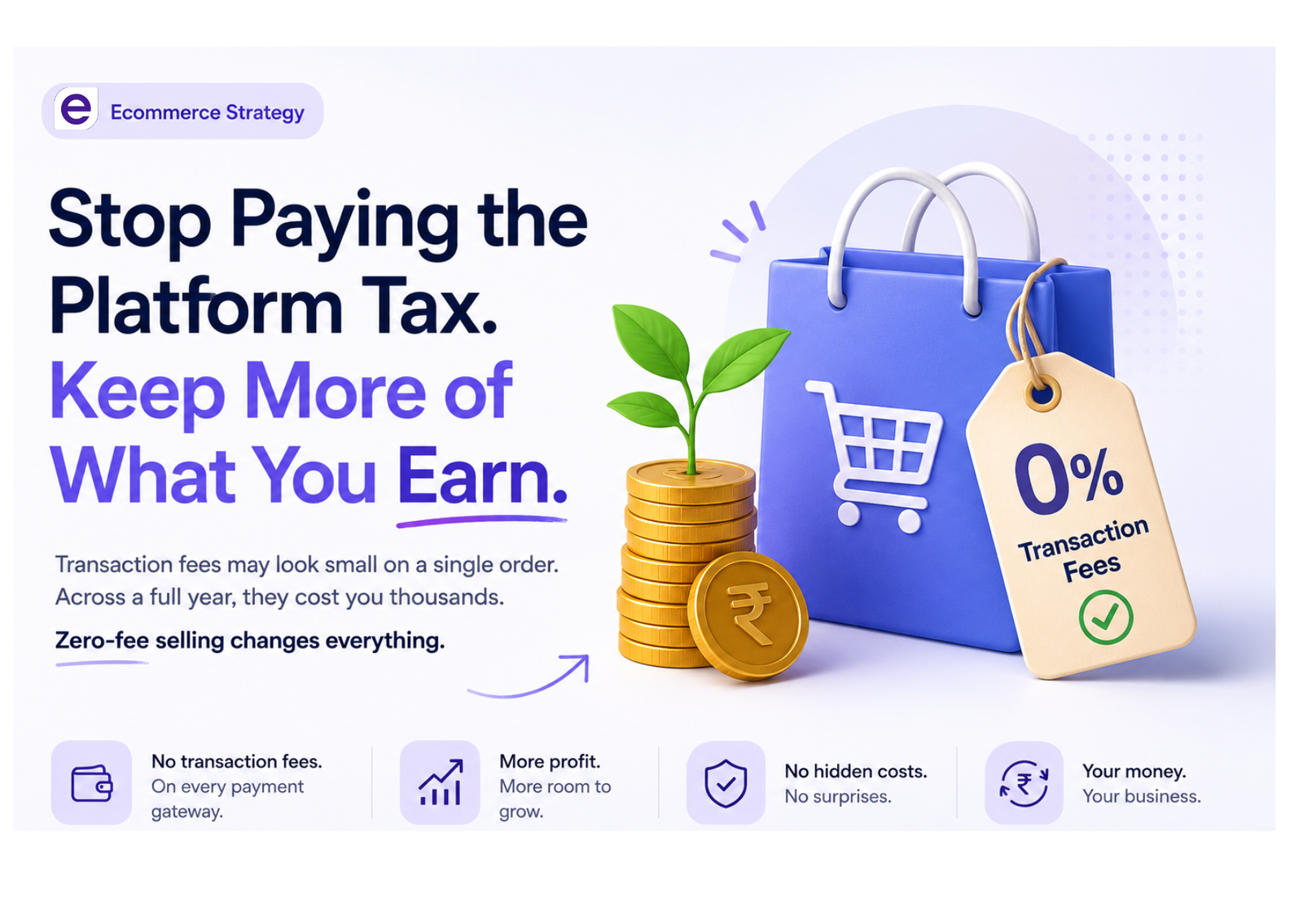
Stop Paying the Platform Tax What Transaction Fees Really Cost Your Store in 2026
When you run an online store, you focus on the big costs: inventory, fulfillment, customer acquisition, and operations. Transaction fees don't feel like a big deal. "Two percent" sounds like a rounding error. It isn't.
Transaction fees are a tax on every sale you make charged in addition to payment gateway fees, stacking silently on top of your existing costs. They hit harder as your revenue grows. And crucially, they're not mandatory. They exist because some platforms charge them by default and count on merchants not doing the math.
Let's Do the Math Most Brands Skip
Take a real-world scenario: a fashion brand doing $500,000 in annual revenue on Shopify Basic. Here's the full fee picture for that one year.
| Cost Item | Shopify Basic | Ecomplify |
|---|---|---|
| Monthly Plan (×12) | $348 | $0–$199 |
| Transaction Fee @ revenue | $10,000 (2%) | $0 (0%) |
| Payment Gateway (Stripe ~2.9%) | $14,500 | $14,500 |
| Theme / App costs | $480+ | $0 (built-in) |
| Total Annual Platform Cost | $25,328+ | $14,500–$16,888 |
That's $8,440–$10,828 saved every year without changing your pricing, your products, or your marketing. That's the compounding effect of platform choice, entirely invisible until you run the numbers.
At $1M in annual revenue, a 2% platform fee becomes $20,000 per year. At $5M, it's $100,000. The fee scales with your success meaning the better your brand performs, the more you hand over automatically.
Why Platforms Charge Transaction Fees and Why You Keep Paying Them
Transaction fees are a revenue stream. The platform already charges you a monthly subscription. The transaction fee is a second layer charged as a percentage of your sales, meaning it scales up as you succeed. The framing is usually that fees are "waived if you use our payment gateway." But many markets have regional preferences and compliance requirements that mean brands can't always use the platform's preferred payment provider.
On Shopify, you can reduce transaction fees from 2% to 0.5% but only by upgrading to the Advanced plan at $299/month. That's a higher subscription cost to avoid a fee you should never have been paying in the first place. This is the upgrade trap.
What You Lose Beyond the Money
The financial cost is measurable. The strategic cost is harder to see but equally real.
- You can't price competitively when 2% of every sale goes to platform fees you either eat the cost or pass it to buyers.
- You can't run aggressive flash sales or heavy discounts without watching margins collapse beneath fees.
- You can't reinvest in growth ads, inventory, team expansion when platform costs compound as revenue grows.
- Your payment flexibility is constrained certain gateways become expensive choices because layering fees multiplies fast.
For high-volume merchants, the platform fee is often larger than the entire email marketing budget. It scales with success, quietly redirecting margin that could fund customer acquisition, product development, or market expansion.
The Compounding Problem: Fees Grow With You
A 2% fee on $100,000 in monthly revenue is $2,000. On $500,000 it's $10,000. On $1,000,000 it's $20,000. The better your store does, the more you pay. Every brand's goal is to scale but when your platform's fee structure means every $1M of growth hands $20,000 to your ecommerce platform automatically, that "scale" costs more than it looks.
Over three years, a brand doing $1M annually pays $60,000 in platform transaction fees alone on top of payment processing, subscriptions, and apps. That's a full-time hire, a product line expansion, or a significant ad budget. Gone. To a line item most finance teams never audit.
What to Do About It Right Now
- Calculate your actual platform cost this year subscription + transaction fees + app fees. Most finance teams are surprised by the total.
- Compare total cost of ownership, not just monthly plan price. The plan is rarely the biggest line item.
- Use a platform with 0% transaction fees from day one not as an upgrade or a workaround, but as the default.
- Redirect saved fees into customer acquisition or retention. It's the highest-leverage reinvestment for scaling brands.
- Don't wait until you're at $500K revenue to think about this. Fees compound earlier than most people expect.
Ecomplify: Zero Platform Transaction Fees, Always
Ecomplify charges 0% platform transaction fees across all plans, on every payment gateway Stripe, PayPal, Apple Pay, Google Pay, Klarna, and Adyen. No fine print, no gateway restrictions, no upgrade required. What you earn from your customers stays in your business, not in a platform's revenue report.
Calculate your savings → See exactly what your current platform fees cost you annually and what keeping that margin could fund instead.
Frequently Asked Questions
What are platform transaction fees?
Platform transaction fees are additional charges levied by your ecommerce platform on every sale, separate from your payment gateway's processing fee. They are typically a percentage of the order value and scale directly with your revenue.
How much do Shopify transaction fees cost at scale?
On Shopify Basic, the platform transaction fee is 2% per order when Shopify Payments is not used. For a brand doing $500,000 annually, that's $10,000 per year in platform fees alone before payment processing, apps, or subscription costs.
Can I avoid Shopify transaction fees?
You can reduce them by upgrading to Shopify Advanced ($299/month) to drop the fee to 0.5%, or by using Shopify Payments where available. However, many brands require multiple gateways or operate in regions where Shopify Payments is unsupported in which case the fee applies regardless.
What is the best ecommerce platform with no transaction fees?
Ecomplify offers 0% platform transaction fees on every plan, with no gateway restrictions. You pay only your payment provider's standard processing fee the same rate you'd pay anywhere and keep 100% of your sales revenue.
Do transaction fees affect my pricing strategy?
Yes. A 2% platform fee either erodes your margin or forces you to raise prices. For competitive categories with thin margins, that fee can be the difference between profitable and unprofitable unit economics.
Last updated August 5, 2026