
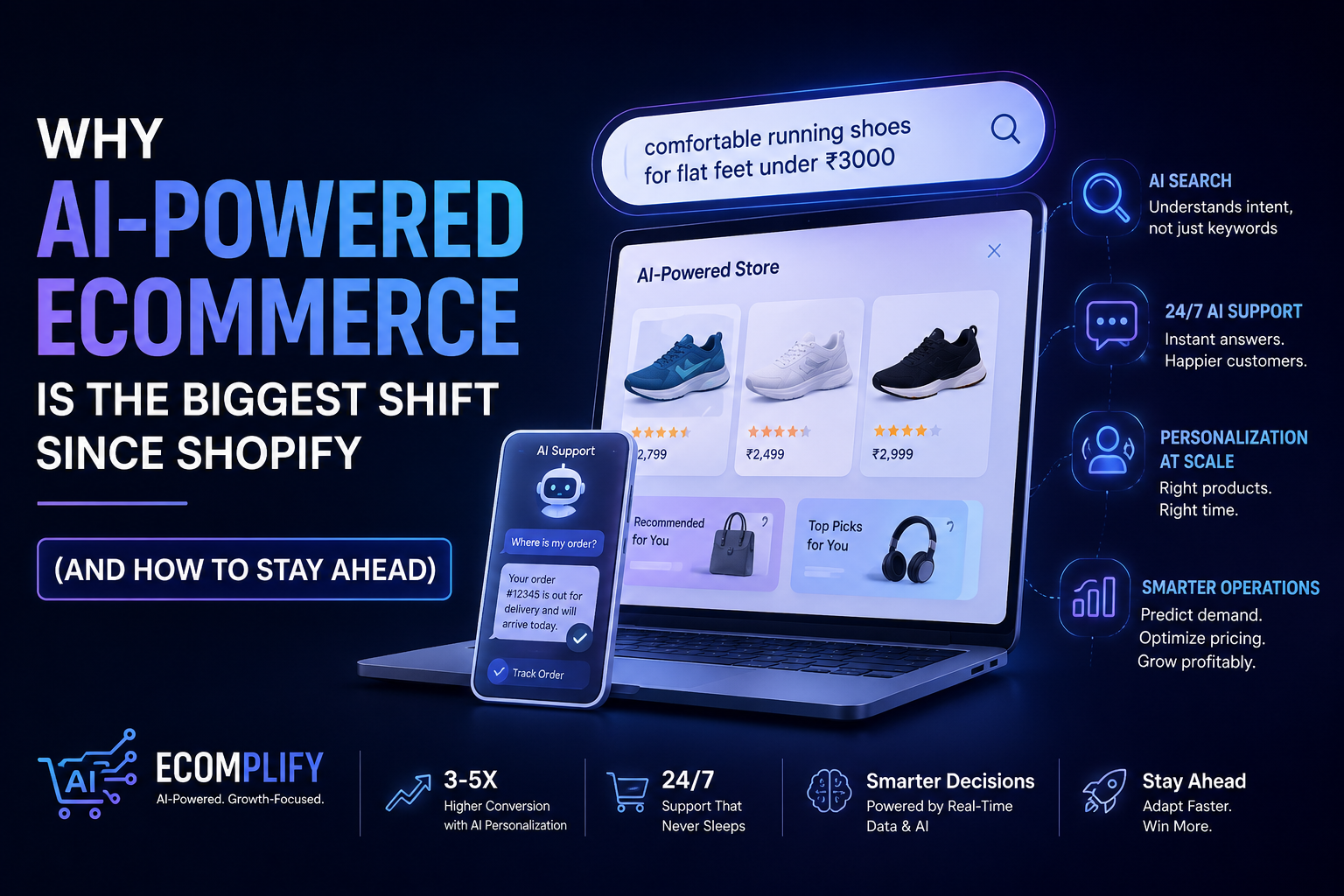
AI-Powered Ecommerce in 2026
Why Traditional Stores Are Falling Behind And What to Do About It
AI is not just another ecommerce trend.
It is becoming the operating system behind modern online retail.
There is a major shift happening in ecommerce right now.
And most store owners are still underestimating how significant it actually is.
This transformation is not about a new marketing channel.
It is not about a viral product trend.
And it is definitely not just about chatbots.
The entire infrastructure of online shopping is changing.
The way customers:
- discover products,
- search,
- compare,
- ask questions,
- make purchasing decisions,
- and interact with brands
is being rebuilt around AI.
Stores that adapt early are already seeing measurable advantages in:
- conversion rates,
- customer retention,
- operational efficiency,
- support costs,
- and overall revenue growth.
Meanwhile, traditional ecommerce stores relying on outdated systems are beginning to fall behind faster than most realize.
And the gap is widening every month.
The Ecommerce Industry Is Entering a New Era
Back in the early mobile era, many businesses ignored mobile optimization.
Desktop websites were still “working,” so adapting felt unnecessary.
But eventually the market changed completely.
Mobile-first companies won.
Everyone else struggled to catch up.
The same pattern is happening again in 2026.
Except this time the transition is moving even faster.
AI-powered ecommerce is rapidly becoming the new standard.
And customers are already adjusting their expectations around it.
They now expect:
- intelligent search,
- instant support,
- personalized recommendations,
- conversational shopping,
- faster checkout experiences,
- and smarter product discovery.
The stores that cannot provide those experiences increasingly feel outdated.
Even if the customer cannot explain why.
The Numbers Behind the Shift
Global ecommerce is projected to exceed $6.88 trillion in 2026.
But the more important story is happening inside that growth.
AI-powered ecommerce stores are significantly outperforming traditional stores in several critical areas.
| Metric | Traditional Stores | AI-Powered Stores |
|---|---|---|
| Product Discovery | Manual filtering | Intent-based search |
| Customer Support | Delayed responses | Instant AI support |
| Personalization | Generic experiences | Real-time dynamic personalization |
| Conversion Rates | Lower | Significantly higher |
| Operational Efficiency | Reactive workflows | Predictive automation |
| Customer Retention | Inconsistent | Stronger repeat behavior |
Many stores implementing AI personalization systems are reporting:
- 3x to 5x higher conversion rates
- Lower bounce rates
- Increased average order values
- Better retention metrics
- Reduced support overhead
These are not experimental systems anymore.
They are already running inside real ecommerce businesses generating real revenue.
Right now.
What AI Actually Looks Like Inside Modern Ecommerce
A lot of discussions around AI remain frustratingly vague.
People say things like:
“AI will transform ecommerce.”
But they rarely explain what that actually means operationally.
So let’s break it down properly.
1. Product Discovery Is No Longer Keyword-Based
Traditional ecommerce search was built around exact keywords.
A customer typed:
running shoes
Then manually browsed through endless product grids.
This system worked poorly because humans do not naturally think in exact search keywords.
Customers actually search using intent.
Today people type things like:
comfortable running shoes for flat feet under ₹3000
that I can wear casually to the office
Traditional search engines struggle with queries like this.
AI-powered search systems do not.
Modern AI search understands:
- context,
- user intent,
- budget sensitivity,
- behavioral patterns,
- previous browsing activity,
- semantic meaning,
- and conversational phrasing.
The result is dramatically better product discovery.
Instead of feeling like a database query, shopping starts feeling like a conversation.
And that changes customer behavior significantly.
Why Better Product Discovery Matters So Much
Most ecommerce stores lose potential customers before products are even discovered.
This is one of the largest hidden conversion problems in ecommerce.
Customers leave because:
- they cannot find relevant products,
- search results feel generic,
- filtering is frustrating,
- or discovery takes too much effort.
AI-powered search reduces friction dramatically.
Customers find products faster.
Relevant products appear earlier.
And fewer users abandon sessions.
This directly improves:
- conversion rates,
- session duration,
- engagement,
- and revenue per visitor.
2. AI Support Is Changing Customer Expectations
Customer support has historically been difficult to scale.
Especially for growing ecommerce brands.
Customers ask questions at all hours:
- Where is my order?
- Can I return this?
- Is this available in another size?
- Which option should I buy?
- When will this restock?
- Is shipping free?
Traditional support teams cannot scale infinitely.
AI support systems solve this differently.
Modern AI agents can now:
- answer support queries instantly,
- access order information,
- track shipments,
- process return workflows,
- recommend products,
- and escalate complex issues to humans only when necessary.
This creates a massive operational advantage.
Instead of hiring increasingly larger support teams, stores can automate repetitive workflows intelligently.
For many stores:
60–70% of support tickets are repetitive.
AI systems can eliminate most of that workload.
That reduces costs while simultaneously improving customer experience.
Which is rare.
3. Ecommerce Personalization Is Finally Becoming Real
Physical retail always had one major advantage:
Human observation.
Good salespeople naturally adapt to customer behavior.
They notice:
- hesitation,
- browsing patterns,
- product interest,
- style preferences,
- and buying signals.
Traditional ecommerce websites historically failed here.
Most stores still show:
- the same homepage,
- the same products,
- the same recommendations,
- and the same banners
to every customer.
That approach leaves enormous revenue untapped.
AI personalization changes this entirely.
Modern personalization systems can adapt dynamically using:
- browsing behavior,
- purchase history,
- session engagement,
- product affinity,
- cart interactions,
- time-on-page,
- repeat visits,
- and customer intent signals.
This creates shopping experiences that feel individually tailored.
And personalized experiences consistently outperform generic ones.
The Psychological Impact of Personalization
This part matters more than most businesses realize.
Customers are not just buying products.
They are evaluating experiences.
When a store feels:
- intelligent,
- relevant,
- responsive,
- and personalized,
customers subconsciously perceive it as more trustworthy and higher quality.
That affects:
- purchase decisions,
- repeat purchases,
- brand loyalty,
- and recommendation behavior.
AI personalization is not just a technical upgrade.
It is a perception upgrade.
4. Smarter Inventory & Predictive Operations
Inventory management is still reactive in most ecommerce businesses.
The typical workflow looks like this:
- Product demand spikes unexpectedly
- Inventory runs out
- Sales are lost
- Restocking happens too late
Or:
- A product slows down
- Inventory accumulates
- Dead stock grows
- Discounts happen reactively
AI forecasting systems solve this differently.
They analyze:
- sales velocity,
- seasonal trends,
- demand patterns,
- competitor activity,
- customer behavior,
- and inventory movement
to predict changes before they happen.
This enables stores to make smarter operational decisions proactively instead of reactively.
That becomes increasingly important as stores scale.
Dynamic Pricing Is Also Becoming Smarter
Pricing decisions are also evolving.
Traditional ecommerce pricing is usually static.
But AI systems can now adjust pricing dynamically based on:
- competitor pricing,
- demand fluctuations,
- inventory pressure,
- conversion behavior,
- and customer purchasing patterns.
Large enterprise retailers have used systems like this for years.
The difference in 2026 is that platforms like Ecomplify are making these capabilities accessible to growing ecommerce businesses as well.
What Most Ecommerce Stores Are Getting Wrong
A common pattern is happening across thousands of stores right now.
A business owner hears about AI.
They install a chatbot.
Then they claim they are “using AI.”
That is not AI-powered ecommerce.
Real AI integration is not a single widget.
It is an interconnected infrastructure layer operating across the entire customer journey.
That includes:
- product discovery,
- recommendations,
- support,
- personalization,
- analytics,
- automation,
- retention,
- and operational intelligence.
The system continuously improves using data.
And that learning compounds over time.
The Biggest Mistake Is Waiting Too Long
Many ecommerce businesses still think:
“We’ll implement AI later.”
The problem is that AI systems improve through data accumulation.
Every week your competitors are collecting:
- customer interaction data,
- behavioral signals,
- search intent patterns,
- conversion data,
- personalization feedback loops,
- and operational intelligence.
Their systems improve continuously.
That advantage compounds.
The longer businesses wait, the harder it becomes to catch up later.
How Smart Stores Are Adopting AI
The smartest ecommerce businesses are not rebuilding everything overnight.
They are adopting AI strategically.
Usually in layers.
Step 1 - Upgrade Product Discovery
AI-powered search often delivers the fastest visible ROI.
Benefits include:
- better discovery,
- lower bounce rates,
- improved conversion rates,
- and stronger customer satisfaction.
Step 2 - Automate Repetitive Support
Most ecommerce support tickets are repetitive.
Automating these workflows frees human teams to focus on:
- high-value customers,
- complex issues,
- and relationship-building conversations.
Step 3 - Implement Personalization
Once search and support are optimized, personalization becomes the multiplier.
This is where stores begin maximizing:
- average order value,
- customer retention,
- conversion efficiency,
- and lifetime customer value.
Why Ecomplify Exists
Most ecommerce businesses today are forced to stitch together disconnected tools:
- one platform for search,
- another for support,
- another for analytics,
- another for automation,
- another for recommendations,
- another for personalization.
This creates fragmented infrastructure that becomes difficult to scale.
Ecomplify was built differently.
Ecomplify is designed as a connected AI-powered ecommerce infrastructure platform for modern online stores.
Instead of juggling disconnected tools, businesses can unify critical AI-powered workflows into a single intelligent ecosystem.
What Ecomplify Helps Ecommerce Stores Do
With Ecomplify, stores can:
✅ Deploy AI-powered product search
✅ Improve product discovery
✅ Automate customer support
✅ Personalize shopping experiences
✅ Reduce operational overhead
✅ Improve conversion efficiency
✅ Scale customer interactions intelligently
✅ Build smarter ecommerce infrastructure
The Future of Ecommerce Will Be AI-Native
The ecommerce businesses winning in 2026 are not necessarily the businesses with:
- the biggest budgets,
- the largest teams,
- or the most products.
They are the businesses building smarter systems underneath their operations.
Systems that:
- learn,
- adapt,
- optimize,
- and compound over time.
AI is rapidly becoming the foundation layer of modern ecommerce.
The debate about whether AI matters is already over.
The real question now is:
How quickly can businesses implement it effectively?
Final Thoughts
AI-powered ecommerce is no longer a future concept.
It is already reshaping customer expectations and competitive advantage across the industry.
The stores adapting early are building long-term advantages that become increasingly difficult to replicate later.
The window to move early is still open.
But it will not remain open forever.
Explore Ecomplify
Website: https://ecomplify.com
Blog: https://ecomplify.com/blog
Start Building Smarter Ecommerce Infrastructure: https://ecomplify.com
Ecommerce is no longer just about selling products online.
It is about building intelligent systems that continuously improve customer experiences.
And AI is becoming the engine behind those systems.
Last updated May 31, 2026